Hello folks! As we start waving goodbye to this rather warm month of July, I thought it would be a great opportunity to gather my thoughts on a topic that seems very confusing and mysterious for many people: vocal registers. Quite frankly this was a grey area for me too when I started singing, and although it is quite a central part of training, not many people really know what they are or how they really work. So I thought I’d take the chance to share some insights and make it the topic of the month.
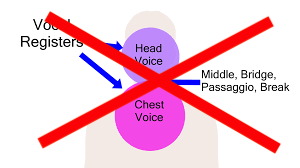
At some point in our lives, every singer has come across terms like ‘chest voice’, ‘mixed voice’ and ‘head voice’. These terms are often used to give a quick queue to someone or a general reference as to where the piece or section of it should sit in a singer’s vocal range. I myself do use these terms, and there’s nothing wrong with them as they have become very largely used on the internet as well giving everybody a bit of knowledge that we can all relate to, however in professional singing and vocal training they can be a bit misleading at times. This is mainly because of three distinct reasons: 1) they are very subjective, 2) they only tell you where the sound should be resonating the most and 3) they tend to push people into thinking these are boxes that the voice lives in.
1) These terms are very subjective. To give you an idea, as a male vocal coach what I consider chest voice is very unlikely to be the same for a female student. But also, even for a male student this could be misleading and not very specific because we all have different ranges. With the human voice being such a unique instrument, we all have it working in very similar ways but the extent and outcomes are always different. Using words like ‘chest/mixed/head’ voice is only helpful to beginner students to offer a quick reference as to where the musical piece should sit. These terms do not bring any real technique to the table, they are just labels created to identify common terms that can be understood easily.
2) Resonance and not quality. As we all know by now, the human voice creates sounds that resonate in different parts of the body. Low sounds tend to resonate more in the upper chest (rib cage area), medium/high sounds should start moving towards your cheeks and finally high sounds will find great resonance in your upper skull parts like nose and temples. This is why the voice can be labelled as chest, mixed, or head. But what do we know about the quality of the sound? Nothing. We only know where we should feel it, yes, although we have no information on how it’s made or what qualities it should have.
3) The voice is NOT made of steps/boxes. There is no such thing as ‘voice gap’ or ‘missing note’ in anyone’s register. The voice is an extremely fluid instrument that is capable of performing from bottom to top (and vice-versa) range without breaking and tearing apart. Now, I’m not saying it’s easy (actually this is most likely one of the biggest hurdles for most singers), however it is absolutely true. Thinking that chest voice and mixed voice are different things… is not my favourite way to look at things as it creates this idea that it takes something extra to go from one to the other while in reality… your registers are all created by the same thing: your vocal cords. Obviously there are many different mechanisms that allow you to transition from one area of your voice to the other and many parts to take into consideration, but I always want to encourage people to think that the voice is one instrument, fluid, free and flexible. Therefore, when it comes to registration and vocal registers I personally like to use different models that actually apply to the anatomy of the voice, making the this topic a lot clearer as well as relatable to anyone regardless of range, gender and skill set. If you’d like to know more about this topic or feel in need of a new approach, please get in touch with me via email on DM on Instagram and we can take it from there 🙂
As I said in the premise though, there is nothing majorly wrong with these terms at all, but since you are here I believe that you are trying or already are taking your skills to the next level and gain a new sense of confidence in your instrument and how it works. So I hope you have enjoyed a quick peek at this HUGE world that vocal registers is, and I will be happy to keep sharing more facts on the topic in the future too. Now, as always, enjoy a couple of links to external resources if you’re curious to find out more! See you all next month! 🙂
CLICK HERE TO WATCH DR. DAN’S TAKE ON THIS TOPIC
CLICK HERE TO READ ABOUT MORE ADVANCE DR. HIRANO’S APPROACH AND RESEARCH